

What Now - Revisited
How to take care of yourself and each other

I wrote the original What Now post after the 2024 American election, a time when anxiety and distress were high among the many hundreds of thousands of people who knew their lives and rights would be threatened by the election results. In the last year, we’ve seen those fears realized: access to safe reproductive care has been stripped, funding to social and scientific endeavors eliminated, gender affirming care and trans rights denied, and immigrants’ basic constitutional rights violated.
In my original post, I wrote:
While Dog Lover’s Guide is not a political newsletter, the reality is we can’t separate politics and mental health. If you can’t get addiction treatment because your addiction is considered a legal or moral problem instead of an illness, your mental and physical health is political. If you can’t get your child the gender affirming care they need because it’s been made illegal, your child’s mental health and wellbeing is political. If you can’t find an OBGYN for your pregnancy because they’ve all fled the state, your health and safety is political.
For anyone whose rights have been threatened or denied because of their race, ethnicity, sex, immigration status, gender identity, or sexual orientation, the personal is political. My mental health, and the mental health of everyone in these groups, is fused with politics.
Today, I want to revisit that post as the nation reels from the murder of Renee Nicole Good in Minneapolis, and the shooting of two people in my own town, Portland. Those of us in the cities under siege are overwhelmed and terrified, but also furious. A friend of mine, a mother of two in Minneapolis, told me earlier this week, “I just heard [ICE] is going door to door a few blocks away. People are accidentally coming across their chaos. Will I get hurt? Or die? Will my kids?” Her husband was late coming to pick her up, and she worried he got caught up in something ICE-related, that he’d been arrested or murdered.
Those of us watching from other places are appalled and unsure how to help, aside from bearing witness from our phone screens. It can be paralyzing, to see all that’s happening and feel like we need to do something, but not knowing what.
In the wake of the election, many of my patients felt despair. They needed to do something, but didn’t know what or how. Maybe you feel that way now.
This is what you can do. And above all, be brave.
I grew up on hero stories: Harry Potter, Lord of the Rings, Star Wars, the Chronicles of Narnia, and so many others. These stories taught an inspiring morality: that anyone, even the most unassuming hobbit or orphan, could be a hero, which meant it was everyone’s duty to try.
What these stories also inadvertently taught was that we had to be the hero for our contribution to count. We had to sacrifice everything, face the Big Bad mano a mano, and defeat him.
Alone.
I am not the hero of this story, and neither are you. You don’t have to be. You can’t be.
There is no one person who’s going to stop the extra-judicial action of ICE against immigrants and American citizens. If you try to be the hero, you will either burn out quickly or never even get started because the task is too daunting to begin.
A dear friend and mentor told me that anything I decided to do needed to be something I could do in the long run. “For it to make a difference,” he said, “it has to be sustainable for a long time.”
In the spirit of his advice, let me offer this framework.
Establish Safety
Safety can mean a lot of things. If what’s happening has impacted your mental health, establishing safety may mean calling a crisis line, finding a therapist, talking to your doctor, taking your medication as prescribed, or spending more time with trusted people. See the end of this article for resources.
If you feel a lack of control or agency in your life, learning about your rights or gathering supplies may help you establish safety. Sometimes establishing safety can be the grounding experience of snuggling with your dog.
Think about what ways you feel unsafe, and how you can take back some of that – even if it’s just a little bit. Find what you have control over, and pour your energy into that.
Connect to Community
Find your safe people and spend time with them. Take time to feel what you’re feeling with them. Ask them for help, and give them help too. You are not alone.
Find other people who need community and welcome them in. Go meet your neighbors. Connect with the people who physically surround you.
Find Your Cause
There are so many things to worry about right now. Remember: you are not the hero of this story, and you are not going to be able to solve everything.
If you fragment your energy, you will be less effective.
If you overuse your energy, you will burn out and no longer be effective.
If you get overwhelmed and freeze, you will not be effective at all.
Think of yourself as part of a collective. Remember what my mentor said: find something sustainable and do that. Trust that other people are working on other things, and keep your eyes on your cause.
Do Something Small Every Day
You are not Aragorn. You are soldier number 242. You matter, your presence is absolutely necessary, but your part is small. Your job is to do something to contribute to your cause every single day, or week, or month. That could be giving money, making hopeful art, writing letters, volunteering, texting your friend who needs support, or creating safe spaces for people who aren’t safe. It could be going to your local school at drop off and pickup times, acting as a citizen observer, or refusing to shop at places that have contracts with ICE. It could be a hundred other things.
Whatever it is, do it. And then keep doing it. Don’t stop doing it.
Make Fun of Fascism
In Blueprint for Revolution: How to Use Rice Pudding, Lego Men, and Other Nonviolent Techniques to Galvanize Communities, Overthrow Dictators, or Simply Change the World, Srdja Popovic shares how he and his fellow students used nonviolent, creative, and funny ways to oppose and ultimately depose Serbian/Yugoslavian dictator Slobodan Milošević. Popovic dedicates an entire chapter to what he calls laughtivism.
“If you’re a cop, you spend a lot of time thinking about how to deal with people who are violent. But nothing in your training prepares you for dealing with people who are funny. This is the genius of laughtivism.”
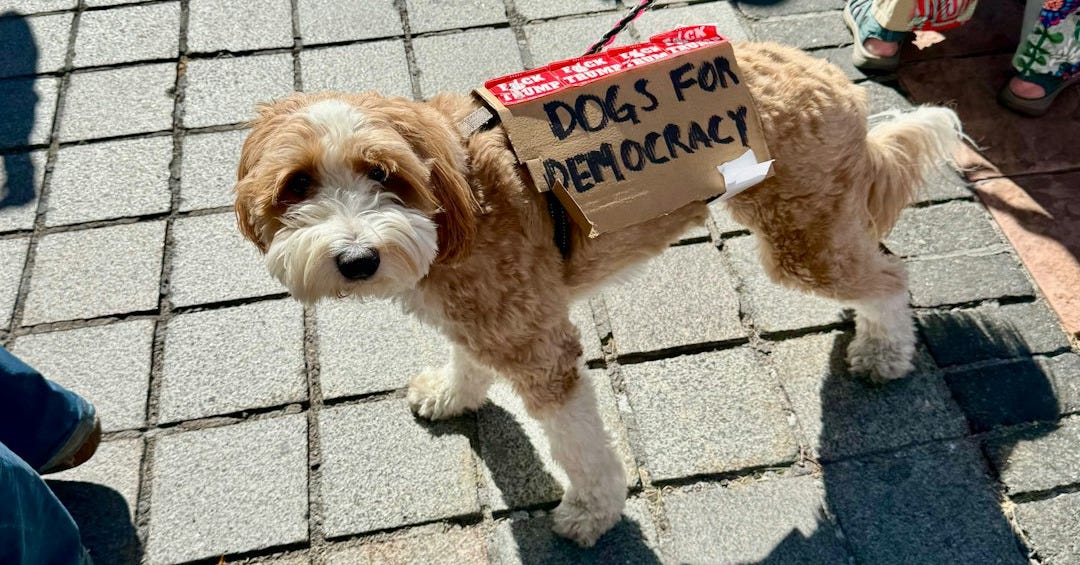
So how do you want to laugh at fascism? Maybe, like Tim Walz, you could call them weird. You could take a page out of my town’s book and don chicken, frog, and unicorn costumes. Or like the Russian toy protest, you could equip Lego figurines with protest signs and glue them to your fence (they can’t arrest a Lego man). Do things that make you giggle, that make other people stop and smile. Joy is resistance. And fascists can’t stand to be laughed at.
Empathize
Immigrants and BIPOC people do not feel safe right now, especially in communities with any kind of ICE presence. But maybe you’re not in those groups. Maybe your life is largely unaffected by ICE, but your heart is breaking for everyone who cannot say the same. If you are in this group, thank you. Thank you for your empathy, for caring about something that doesn’t personally impact you.
Sharon Salzberg, a teacher of loving kindness meditation, says the heart of true morality is empathy. Defined as the ability to understand what someone else is experiencing even when their situation is different from your own, empathy is central to both mental and societal health. If ICE isn’t affecting your life, please extend empathy to those who are afraid. Make empathy central to your morality.
Over the next week, I’m going to repost some classic Dog Lover’s Guide articles about self-care. I hope they help you find your center, but don’t stop there. Find your center, and use that balance and groundedness to steady someone else. Take care of each other. Be brave.
Resources
National Crisis Line: Call or text 988
Trevor Project: text 678-678 | call 866-488-7386
Trans Lifeline: 877-565-8860
Thank you for this essay. I have been feeling a low-grade level of PTSD because of what is happening in our country. I need to take action so that I don't feel totally helpless. Thank you for providing a couple of things I can do to make my neighbors feel safer.
Thank you for your words and thoughts.